Loretto Analysis- Masterpiece
of Potency
Pedigree Analysis of a Foundation of the Holstein Breed
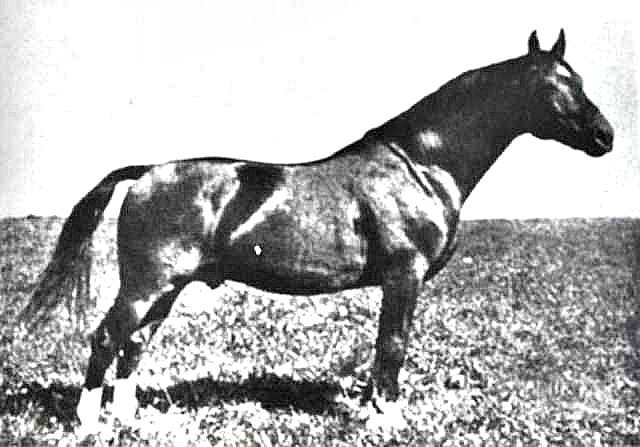
Above is a image of Loretto HO, a strong foundation sire of the Holstein breed.
Let's get some things clear right away, because there a massive amount of inaccurate sales propaganda surrounding all the European breeds let me present Loretto HO as a shining example of what really is powering the European warmbloods.
With all my decades of pedigree database building, tracing lineages, accessing historical archives, I have yet to find the mythical centuries old European developed sport horse breed in evidence. What I have found, and Loretto HO is a perfect example of, is that it was a farm horse until the Anglo breeds were brought in to improve it. In following bloodlines back, the only bloodlines recorded before the mid-1800s are Anglo breeds--the trotting and racing stock developed on the British Isles and even some from America.
In Europe, the only exception I can find where the lineages go past the mid-1800s is in the East Prussian and Trakehner, where there is some evidence of organized breeding a little earlier, and generally, although most of the European lines vanish before they travel back the mid-1800s or run into the Anglo breeds by then, there are a few that continue on in partial lineage, to the turn of the century, but they too run into Thoroughbred. Following all these pedigrees back through time it appears as if the those fabled inspectors and recorders just didn't find it of any importance to record any stock unless it had some Anglo foundation. The European lines end with "unknown" after a few generations, and from the mid-1800s backward in time they are virtually non-existent--they have disappeared. Now isn't that curious, I was told their own breed was inspected systematically for hundreds and hundreds of years, and I can't find that breed or any connection to it in their modern warmblood.
Yet on the website of the American Holstein Horse Association (and in the books like The Holstein Horse) you will read that the Holstein can trace its roots back 700 years. And yes, horse breeding was going on in that area 700 years ago, but so it was in EVERY settled area of the world. The gilded history they are serving up to you is a smoke screen. There is no connection with the extinct breeds of the middle ages and their sport horse breed of today. If you carefully read those embellished histories you will see there is no actual connection to the modern Holstein breed. They say they established a stud in the 1700s and so they did, and they also claim careful inspection of those horses--the implication being they are the base of the modern Holstein. You and I both know if a horse is inspected then a choice has been made, and it would be recorded. So, I ask, why is there no record of those 1700s horses in the lineages of the modern Holstein? The English Thoroughbred noted its ancestry back then--it is what is done in order to develop a breed, so did the Hackney, the Cleveland Bay, and even our American Running Horse have pedigrees that travel back then. Why is there no lineage other than Anglo bloodlines in their pedigrees before the mid 1800s? (Recently I check the Holstein website ...5/20...and discovered a responsible researcher had adjusted the narrative of the claim of 700 years and it has been scrubbed from their website. In its place is instead a concise and fairly accurate of the history of the modern sport version, saying they started with a farm horse mares, crossed to TBs, then re-crossed to Irish and English Hunters, and that the sport model was begun after WWII.)
So then, where is the evidence of the centuries old inspection system? It is missing from the record. Recently I discovered there is a good reason for that, because their inspection system for their warmblood sport horse was not created until 1991 according to Dr. Hanfried Haring (head of the marketing and breeding of the entire German wb breeds).
Pedigree Analysis
Loretto, a Holstein stallion born in 1932, has a stature as a superior pre-potent stallion that has stood the test of time. Loretto HO arose from the era when the heavy agricultural horse had been adapted into a stylish coach horse but there were still enough of the heavier stock for agricultural work (draught). The post-WWII movement for selection for a sport horse had not occurred yet (not until 1975 according to Dr. Hanfried Haring). Loretto HO then in type is a 'heavy coach' horse as well as a successful stallion.
Rossow and Tietz said, "The get of Loretto are splendid horses of incomparable dignity, possessing buoyant, springy gaits, which develop along with the horse and delight the observer." Okay, so right here the pretense of hundreds of years of sport breeding ends. It is obvious what they were attempting to do was turn their draft breed into a coach horse. And Loretto HO was valued because he brought not just the needed lightness but a wonderful elastic suspension in his movement.
Loretto pedigree
You will not often see pedigrees as genetically strong as this one is in warmbloods--his sire Lorbeer HO has a strong background build-up of the Ethelbert HO bloodline. Ethelbert HO gave some riding horse points to the Holstein, along with a large dose of elegance and quality. Lorbeer HO was described as a small but wide bodied horse, who had a deep girth, high neck carriage, fabulous gaits, impulsion and enormous presence. He passed on his charisma along with soundness and a good mind. Notice that Ethelbert's 2nd sire is the Thoroughbred Ethelbert--who is a son of Faugh-a-Ballagh, this is a pre-potent jump line. This horse and his full brother Birdcatcher are still powerful jump typesetters in the Thoroughbred and are behind the majority of the jumping lines of Europe. However, Ethelbert HO and Lorbeer HO were coach horse stallions--not sport horse stock, but you can see that the sport base was being laid through lines such as Faugh-a-Ballah, so later when more Thoroughbred and Trotter was added a potency in sport emerged.
On the dam side we find a strong presence of Achill HO 1877--this is still a important bloodline in the Holstein today. Achill HO is the product of extreme inbreeding as his sire Hercules HO and his dam Liesch HO are 1/2 brother and sister. But the gene consolidation goes much deeper because his 2nd sire is Achill YC 1849 who is a pure Yorkshire Coach Horse, by Brilliant YC out of Stern YC. Stern YC is 1x1 to a full brother and sister. If you ever wondered why the Holstein is so recognizable as a type--it is because of background genetics like these--closely bred ancestors that set a distinct type. For instance the equally powerful genetic transmitter Favorit HO is loaded with these same bloodlines (his analysis is found in North American Sport Horse Breeder). These foundations of the Holstein breed are Yorkshire Coach stock--a cross between Thoroughbred and Chapman Horse (Cleveland Bay), and over the years more and more Thoroughbred was added to improve the form and ability.
The Yorkshire Coach Horse was the greatest coach breed of the 1800s; they were large, elegant, fast and powerful trotters. They were prized as carriage horses and hunters, but were also used extensively as 'improvers' for other less stylish breeds. Germany imported huge numbers of these horses, to set a more carriage type into their largely heavy agricultural breeds. The Thoroughbred component in the Yorkshire brought in the sport ability. The Yorkshire Coach Horse, Norfolk Trotter, the French Trotter and the other trotter breeds are fully discussed in Standardbred Sport Horses .
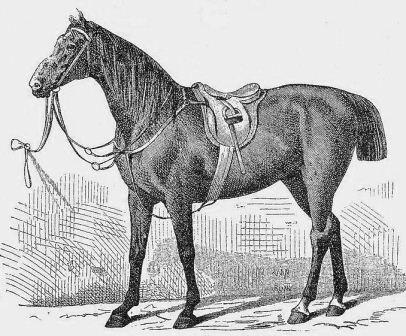
Above is a public domain etching of a Yorkshire found on Wiki Commons.
Of interest to those who like to trace the origin of athletic traits in our horses, in the great modern day jump breeds of Holstein and Selle Francais, you will find that both descend not just from Thoroughbred but from trotter breeds as well. The Selle Francais from the Norfolk Trotter (Hackney) with French Trotter, Anglo-Arab and Anglo-Norman. The French Trotter is a sport horse--it is a racing breed which was developed in the mid-1800s in France, and the sporting elements came to it via the Thoroughbred and Hackney and some American Trotter, not the Arab or Norman draft. The modern Holstein is largely of Yorkshire and Thoroughbred background genetics, the sport ability came from the Thoroughbred.
Besides the Ethelbert HO and Achill HO dominance, there is a third base power in this lineage formed by the full brother stallions Falb/Ali 4x5x5x4 with an extra line of their 1/2 sister Lawine HO in the 5th. This is the genetic equivalent of Falb HO being the grandsire of Loretto HO. Further, full siblings (there are several other groupings here), are the single most powerful genetic design you can build into your pedigrees. Genes form clusters that travel down the genetic trail together, so when you add in several full siblings into a lineage you have created a super-mass of the same genotype, which will overpower any other influences present.
So maybe Falb HO and Ali HO are German based bloodlines? Although Falb carries some East Prussian and Trakehner lines on his sireline, the rest of the pedigree is very similar to Achill HO. Falb HO is inbred 3x5 to Malcolm, a Mecklenburg bred coach horse who is of Thoroughbred and Yorkshire Coach lines, and he is 4x5 to the same Achill HO we discussed above. Mecklenburg Stud was the largest importer of coach, hunting and Thoroughbred stock from the British Isles expressly for the purpose of creating a proper coach horse because the continent's draft horse based horses were too slow and heavy to meet the new transportation needs.
Rossow and Tietz said of Falb HO and Ali HO, "Both stallions were the embodiment of the brilliantly moving, splendid, pure coach horse." Neither of them ever produced any riding horses, only magnificent coach horses. Ali HO had thirty-three stallion sons and Falb HO had forty. Falb HO was considered the most important carriage horse of his era. He had tremendous presence and enormous action in his gaits, with a large frame while still being slab-sided.
Now, all we have discussed above declares Loretto HO possessed a great performance pedigree of the coach type and was a genetic powerful stallion--he would be able to pass his type on reliably. But Loretto HO is one of the greatest European typesetters of all time. And here is why: great stallions and broodmares need what we call filly factors --a strong female element, through full sisters, or several different daughters of a significant sire or both sons and daughters of a taproot mare. This is what the statistics have shown is so. And here in front of us is the living proof. In Loretto HO we find he is 4x4 to the full sisters Wachtel/Vista, he is 6x5x7x6 to Aniketa/Agathe, and he is 7x6x5 to Geel/Liesch.
Just having one of these strong filly factors would guarantee his success as a stallion, but with these three he has the genetic cohesion to last forever in the lineages of champions. His daughters are pure genetic gold in the pedigree.
Loretto HO provided a strong coach horse base that carried enough Thoroughbred and Trotter, so that later on after World War II, when Holstein got around to aiming for a sport horse there was substance and some genetic affinity with sport lines (TB and Trotter) to build on.