American Thoroughbred
Understanding Sprinting Thoroughbred Lines
in Sport Horses
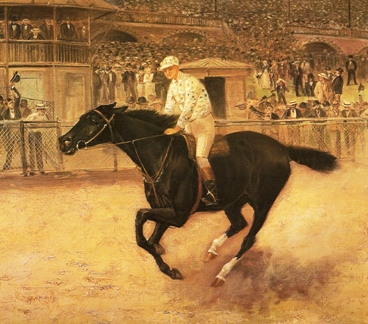
Domino- the all American Sprinter
Its a shame, but the American breeder of warmbloods and sport horses has been coached into a belief that their American brand of Thoroughbred is a sprint only strain, and is a lesser type for sport horse breeding then the more stamina bred Thoroughbreds coming, our European friends say, from other countries such as France, Australia, Germany and Ireland for examples. And our American breeders themselves, after hearing this repeatedly from sport horse 'experts' are now repeating this assessment as if it is gospel.
So, is it true? Is the American Thoroughbred a sprint only breed? The fact is that France is the world leader in producing stamina strains of Thoroughbred, England is a close 2nd and here is the shocker: America is 3rd in world production of stamina racers. But it is even more dramatic than that, because the rest of those other supposedly stamina producing countries hardly make a scratch in stayer production and the American Thoroughbred actually supplies more than twice the amount of stayers as all those other countries combined. I know, you don't believe me--after all you have listened for years to criticisms of the American Thoroughbred from 'experts' at your breed societies. But let me ask you, did you ever do any research on this yourself? I know you didn't, because until I did I believed those 'experts' myself.
Is the modern American Thoroughbred too speed oriented? The Thoroughbred race horse breeding in general--everywhere have been selectively bred for the fast maturing brilliant types. There is a quicker return for the racehorse breeder, if it shows brilliance early on--at two, then it can be sold for a profit or even be put to stud. However, many of the sprinter-bred horses do not train on well, and they lack the stamina to succeed at the classics. In order to get that early brilliance, the breeders must concentrate the speed genetics which can result in too extreme a type. Plenty of American Thoroughbreds are sprinters--that is true, but what is not true is the assumption that is all America produces. The greater truth is that America 'rocks' in all the categories of Thoroughbred--we lead the way in Classic length winners, and this is going to be a shocker--we produce 25% of the world's stayers.
After more research I discovered something else, the bedrock of the modern American Thoroughbred is the superior ancestors it is descended from--and these ancestors, horses like Boston RH and his sons Lecomte RH and Lexington RH, are the greatest distance racers the world has ever seen. I am not exaggerating, the ancestors of our modern Thoroughbred were regularly running four-mile heat races, several times in one race meet--that means they ran four miles, rested for a short while and then they were off on another four mile race--and possibly another--the winner was the best two out of three heats. If there were three or more racers in the race, and if a different horse won each of the three heats, then they would even have a fourth heat. That means these horses could run eight to sixteen miles at a full gallop in one contest. Think about it and read more about the 4-mile racers of yesteryear These racers that could perform at that amazing level and their superior sport genetics are sitting in the background of your pedigrees, no other country came close to this level of sport talent--really! Even England who had 4-mile heat racing, which produced such lasting bloodlines of excellence as Herod and Eclipse, and in the colonies we loved Fearnought, Janus and Diomed, all English 4-mile heat racers, but they switched their performance test to the much less taxing 1 to 2 mile dash race form (classic race) after 100 years. Here in the colonies and the States we kept going with the heat racing another 100 years after that, perfecting the stamina horse to a form and level that have never been equaled since.
[The books Legacy of Lexington (American Thoroughbred history and bloodlines for sport use) and Standardbred Sport Horses (Standardbred history and the important bloodlines for your ridden sport use) were written to awaken the American breeder of sport horses to the tremendous genetic resource they have right in front of them in their domestic racehorse breeds.]
When I first wrote this article I did not have all the information I do now, and was still in part under the 'warmblood spell', so I accepted some of the bias about the American-bred Thoroughbred, and even worried that my own classic length race mare was too close to that dread sprinter type to produce anything good. But now with many years of experience and study under my belt I am much more able to discern the falsity that abounds in our common knowledge in sport horse breeding.
Two things to consider, first the American Thoroughbred produces 25% of the world's modern stayer bloodlines and that is no small amount. Second, the statement that only stamina bred racehorses are good for breeding sport horses doesn't hold water either. Those sprint bloodlines are perfectly acceptable breeding material for all sport pursuits- even the breeders of distance racing Thoroughbreds know that they have to add a speed horse now and then to keep the distance speed. It is the individual bloodline we have to look at, is it sound, and is it a pure sprinter or is it a multi-distance length line.
Tell me, do your warmblood societies say the mighty line of Nearco or his superlative son Nasrullah are too sprint oriented? Nasrullah is everywhere there are winning sport horses no matter the discipline. Read any article about which bloodlines are showing up in show jumpers, the eventers and even dressage horses and you will find him--usually in multiples. Yet Nasrullah, a 1940 Irish-bred, who with plenty of time passed for proper evaluation of his breeding legacy, he is found in the 'Brilliant' column on the chefs-de-race list created by Dr. Roman. Brilliant is one of the sprinter classification columns, and Nasrullah is found only in this one--so this is what his breeding legacy is--Nasrullah is a pure-sprinter sire.
Okay, so the Nasrullah factor poses a problem for the 'no sprinter' dogma in warmblood breeding--showing us once again that the facts do not support the bias. However, now we see that like everything else we have learned--it is the bloodline that matters--if the bloodline is a good sport source--like Nasrullah, or even his sire Nearco isn't a stamina sire either his 'chef-de-race' status is as a classic and sprint sire.
So what is the real story here? Let's examine the sprinting bloodlines in the modern Thoroughbred and I think you will be a little surprised. The equine scholar Alexander MacKay-Smith traced the speed influences in the Thoroughbred in his Speed and the Thoroughbred . He state that the sprinting lines in the modern Thoroughbred all arise from six sires: St. Simon (English TB), Domino (American TB), Americus (American TB), Haversac (French TB), The Tetrarch (English TB) and Phalaris (English TB). That is two American sources and one French and the other three are English. Hmm.
So I guess the American Thoroughbred is not the sprint curse of the sport horse world after all. Let's look at our two lines that made MacKay-Smith's list:
Domino - born 1891 in America, a pre-eminent sprint sire, although his sons Celt and Colin were great classic mid-distance winners and the best of their era. (Colin beat the stayer Fair Play three times including the Belmont Stakes.) Domino is found in dominance in our modern sport horse quite often both Black Toney and Blue Larkspur. Domino is also a powerful bloodline in jumpers.
See how often Black Toney shows up in the top show jumpers.
Domino, who is as close of a guarantee of speed as there ever was, is inbred 3x4x4x4 to Lexington RH and his brother Lecomte RH (sons of Boston RH)--the greatest distance racers of their time, and really any time. They set world records in four-mile heat racing. Domino is a powerful typesetter of speed and overall athleticism and jumpers. So, the greatest modern speed bloodline, Domino, is the result of concentrating (making dominant) stamina sources? Yes!
Americus--also born in the USA (1892), but he was shipped to Ireland where he strongly influenced the European Thoroughbred by producing Americus Girl, the dam of Lady Josephine, who in turn gave us two mares who created racing and breeding dynasties in the English Thoroughbred: Mumtaz Mahal and Lady Juror, who have become the backbone of the modern English Thoroughbred. Americus is also found in the German Trakehner, through the foundation damline of Saaleck TR. (See Legacy of Lexington)
Americus is inbred 2x2 to full siblings The Nun/Norfolk, by Lexington RH out of a mare by Glencoe out of an inbred RH mare Chloe Anderson RH--he is an extremely powerful typesetter as well. And he too, is the result of making great stamina lines dominant!
Domino is everywhere in the American Thoroughbred and Americus is everywhere in the English Thoroughbred, these families are not just good, they are great, the best of their eras, and both of these lines are still today potent providers of the very best in racing and in Olympic style sport. Does your sport horse have Thoroughbred lines in it? Then it most likely carries one or both of these genetic giants in multiples.
"Sprinters are built downhill". Another point we often hear is that a sprinter has low withers and a high hindquarter- 'built downhill'. The great equine scholar MacKay-Smith stated that the high hind quarter we so associate with sprinters comes down the genetic trail from the Godolphin Arabian (a Turkoman). Turkoman horses were best at races of four to twenty miles and they were not good sprinters.--So this is not a sprint linked trait.
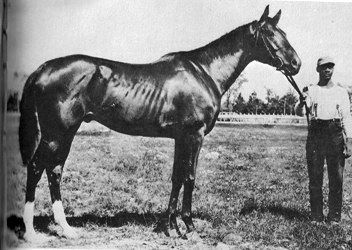
You have a conformation shot of Domino above---it is a pretty level shot, and I found when I set a straight edge on his withers that they were above his hind end--it looks they are an inch or so higher to me--take a look yourself. Is Domino built downhill?
Are you ready for some facts about the American Thoroughbred?
* The American Thoroughbred is unique in that it arose not just from the English Thoroughbred, but also from our American Running Horse.
*Both the English TB and the American RH were developed at the same time out of the same mare base: Irish Hobby and English RH
* The English TB used heat-racing as its performance test for its first one hundred years, until 1760 when it switched to the classic race test
*The American Running Horse used heat racing as one of its performance tests for two-hundred years 1665-1875 (and sprint racing from 1624-1875) and performed their races at the gallop or pace and later at the trot as well.
*The English TB had pacing and trotting racers but culled them out in the 1700s, but early TBs like Bedford, Janus, Miss Hervey, Blaze and Mozart either were pacers or trotters or produced them.
*The American Thoroughbred became a breed in 1868 when a branch of the Running Horse had bred in enough English TB to qualify (5 generations of GSB registered stock) and assumed the classic race performance test. Although that was what was supposed to happen, but the best racers often didn't qualify by the pedigree requirement and so Bruce let them in anyway, changing their breed identification from Running Horse to Thoroughbred (American Running Horse).
*The American Quarter Horse became a separate breed from its parent Running Horse also in this time (1868) keeping the galloping sprinter lines in power.
*The American Trotter existed as a breed from 1818 when it set its first performance test, and the Standardbred became a breed when it gathered the fastest of the Trotters (2:30 minute mile) into it's own register in 1879--the pacing Running Horses were added in 1891
* The American Thoroughbred is one of three world class racehorse breeds that arose from the American Running Horse
* The American Thoroughbred and American Hunter have been competing and winning in INTERNATIONAL sport since mid-1800s.
Thoroughbred and Soundness study
Can the Thoroughbred Still Jump?
Back to The Importance of the Thoroughbred in Sport Horse Breeding
real stayers- see what a real stamina horse is made of 2014 Kentucky Derby and Preakness winner: California Chrome